Advanced Metering Infrastructure (AMI) Platform
Executive Summary Tech4Biz designed and engineered an end-to-end Advanced Metering Infrastructure platform: smart meters and multi-protocol communication, edge data concentrators, a head-end system, a Meter Data Manageme
| Showcase record | |
|---|---|
| Showcase category | Case studies |
| Industry | Energy, Utilities & Smart Grid |
| Published | 20 July 2026 |
Key results
Reduced operational and maintenance cost through remote operations. Metric Before After Meter reading Manual, monthly Automated, interval Billing accuracy Estimated, disputed Actual, automated Non-technical losses Undetected AI theft detection Outage detection Customer calls Meter last-gasp Connect / disconnect Field visit Remote, same-day Demand management No interval data Forecast + DR Customer engagement Paper bill only Web + mobile portal System integration Siloed CIS/ERP/GIS/SCADA.

Executive Summary
Tech4Biz designed and engineered an end-to-end Advanced Metering Infrastructure platform: smart meters and multi-protocol communication, edge data concentrators, a head-end system, a Meter Data Management System with automated validation-estimation-editing, AI analytics for forecasting and theft detection, and web/mobile customer engagement, integrated with the utility’s CIS, billing, ERP, GIS, and SCADA/OMS/DMS.
This document details the problem, the engineered solution, the reference hardware (smart meter and data concentrator), representative operator and customer screens, and the measurable business outcomes
Problem Statement
The client’s existing forecasting and pricing methods were manual and reactive, leading to several inefficiencies:
- Manual meter reading : labor-intensive, error-prone, and infrequent, driving estimated bills and disputes.
- High non-technical losses: theft, tampering, and unauthorized connections with no systematic detection.
- No real-time visibility : consumption, voltage, and outage status invisible between reading cycles.
- Slow outage detection : utility learned of outages from customer calls, not the network.
- Weak demand management : no interval data to support forecasting, peak shaving, or demand response.
- Fragmented systems:metering disconnected from billing, CIS, GIS, and grid operations.
Suggested Solution
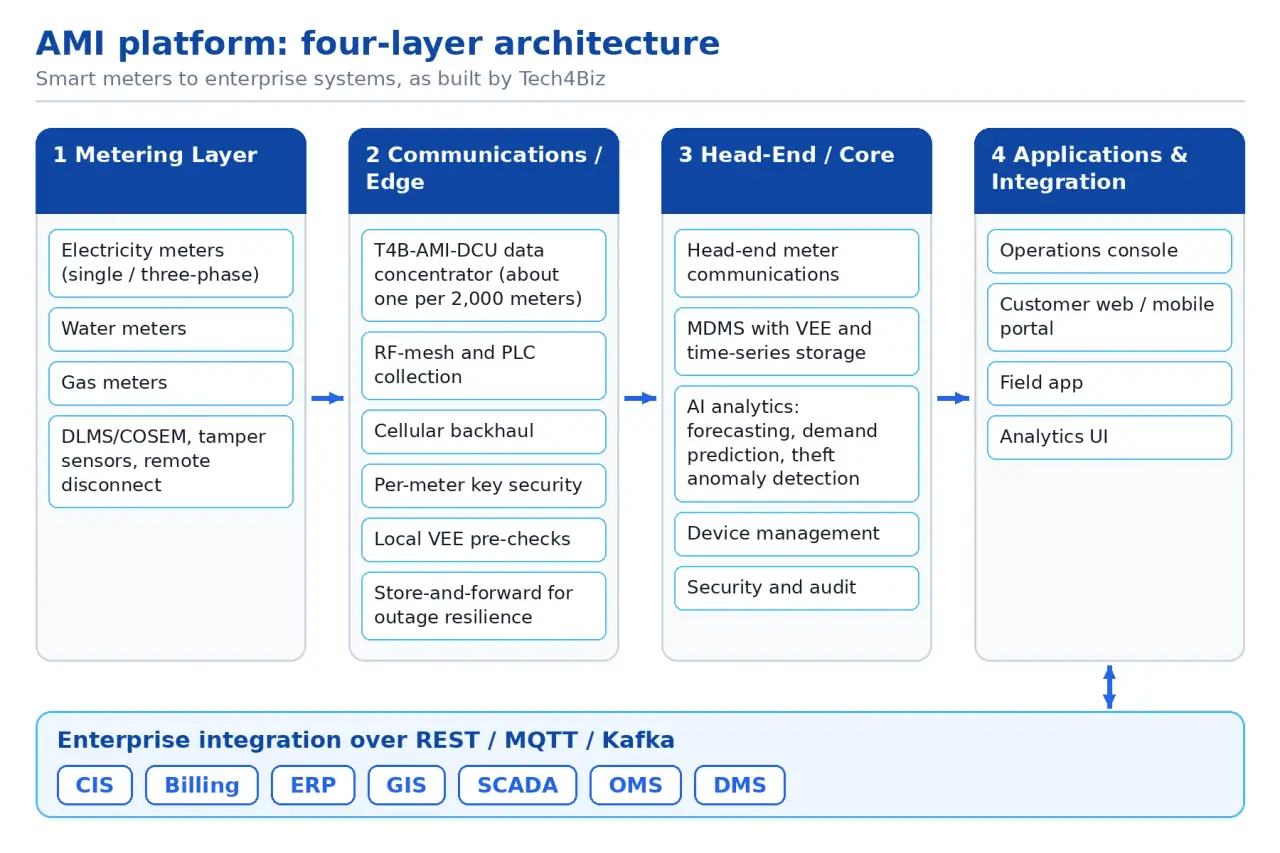
Tech4Biz built a custom AMI platform combining smart meters, RF-mesh/PLC/cellular communications, edge concentrators, cloud MDMS, AI/ML, digital twins, and enterprise integration. The system is structured in four layers: Metering Layer- Electricity (single/three-phase), water, and gas smart meters with DLMS/COSEM, load-survey profiles, tamper sensors, and remote disconnect.
- RF-mesh and PLC collection, cellular backhaul, per-meter key security, local VEE pre-checks, and store-and-forward for outage resilience. Roughly one concentrator per 2,000 meters.
- Head-end meter communications, MDMS with VEE and time-series storage, AI analytics (forecasting, demand prediction, theft anomaly detection), device management, and security/audit.
- Operations console, customer web/mobile portal, field app, and analytics UI, integrated over REST/MQTT/Kafka with CIS, billing, ERP, GIS, SCADA, OMS, and DMS.
Reference Hardware Design
The AMI edge runs on two reference designs engineered by Tech4Biz. Both are presented as engineered reference architectures that guide deployment on certified metering and industrial hardware.
Smart Energy Meter — T4B-AMI-SM-R1
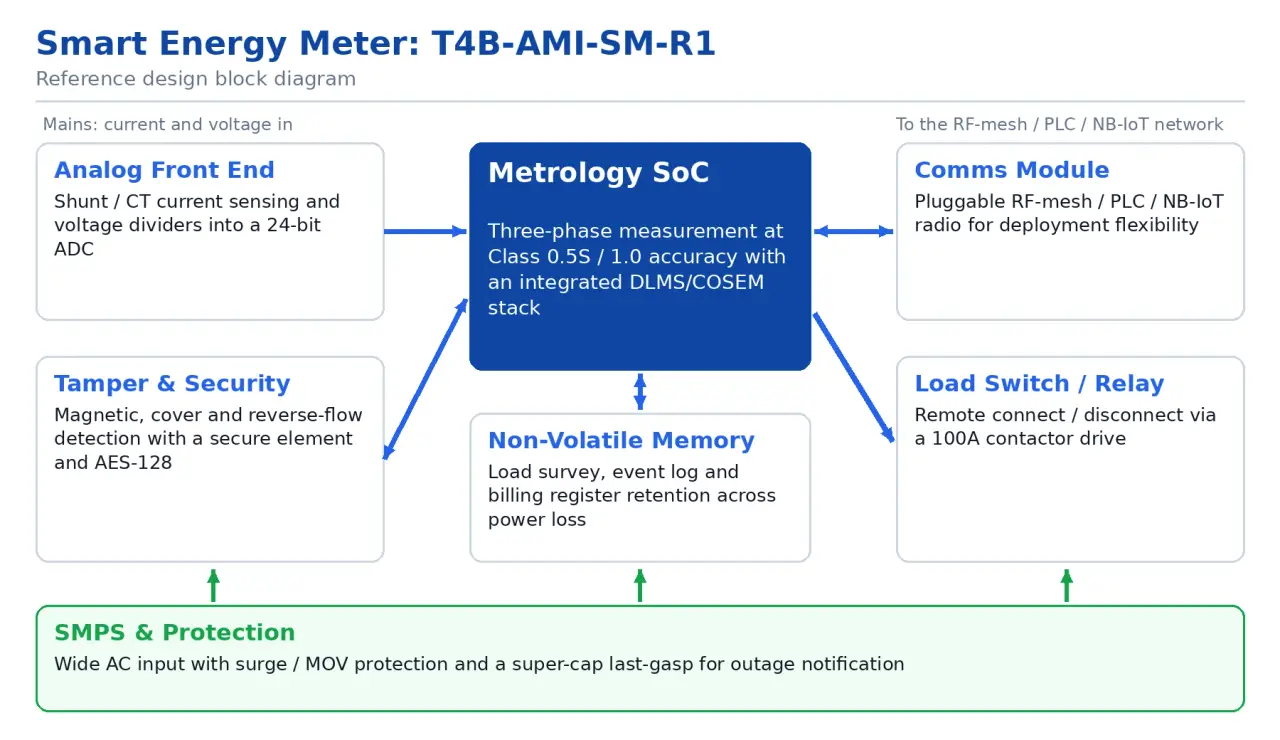
- Metrology SoC : three-phase measurement at Class 0.5S/1.0 accuracy with an integrated DLMS/COSEM stack.
- Analog Front End: shunt/CT current sensing and voltage dividers into a 24-bit ADC.
- Tamper & Security : magnetic, cover, and reverse-flow detection with a secure element and AES-128.
- Load Switch / Relay : remote connect/disconnect via a 100A contactor drive.
- Comms Module : pluggable RF-mesh / PLC / NB-IoT radio for deployment flexibility.
- SMPS & Protection: wide AC input with surge/MOV protection and a super-cap last-gasp for outage notification
- Non-Volatile Memory: load survey, event log, and billing register retention across power loss
Data Concentrator Unit — T4B-AMI-DCU-R1
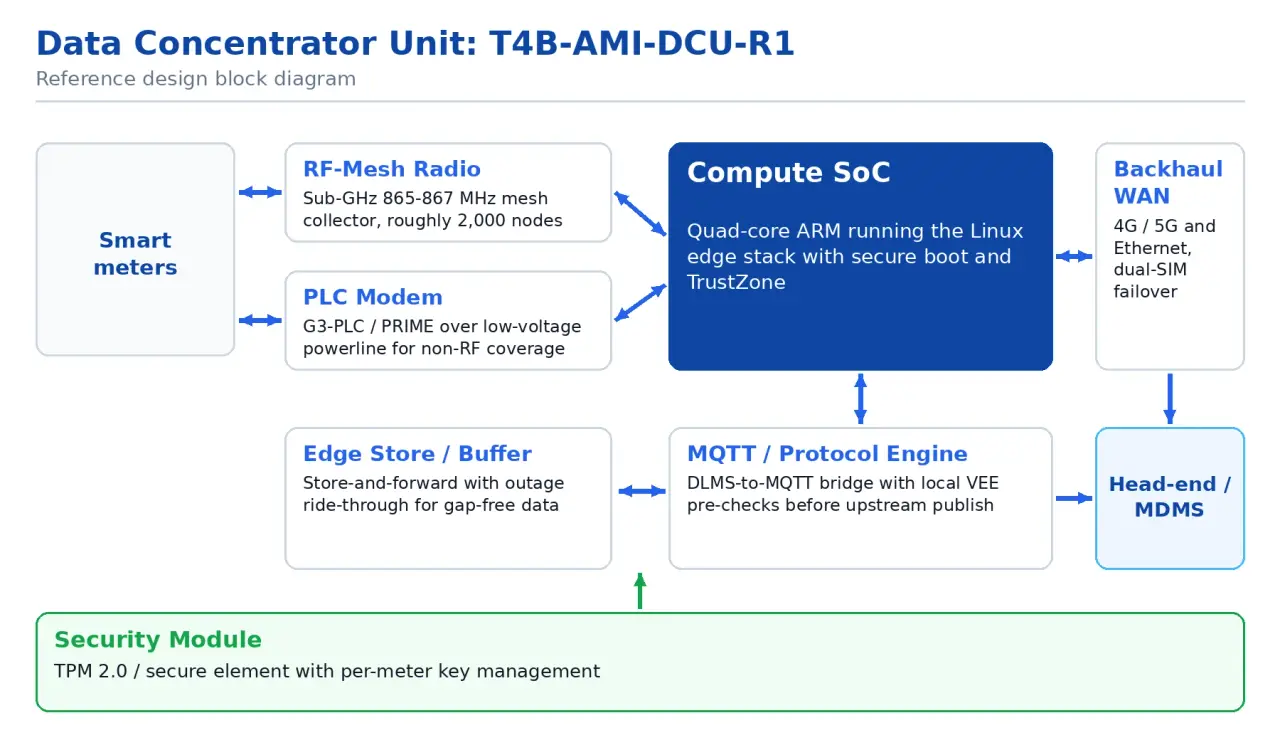
- Compute SoC: quad-core ARM running the Linux edge stack with secure boot and TrustZone.
- RF-Mesh Radio: sub-GHz 865–867MHz mesh collector scaling to roughly 2,000 nodes.
- PLC Modem: G3-PLC / PRIME over low-voltage powerline for non-RF coverage.
- Backhaul WAN: 4G/5G and Ethernet with dual-SIM failover.
- Security Module : TPM 2.0 / secure element with per-meter key management.
- Edge Store / Buffer: store-and-forward with outage ride-through for gap-free data.
- MQTT / Protocol : Engine: DLMS-to-MQTT bridge with local VEE pre-checks before upstream publish.
Operations
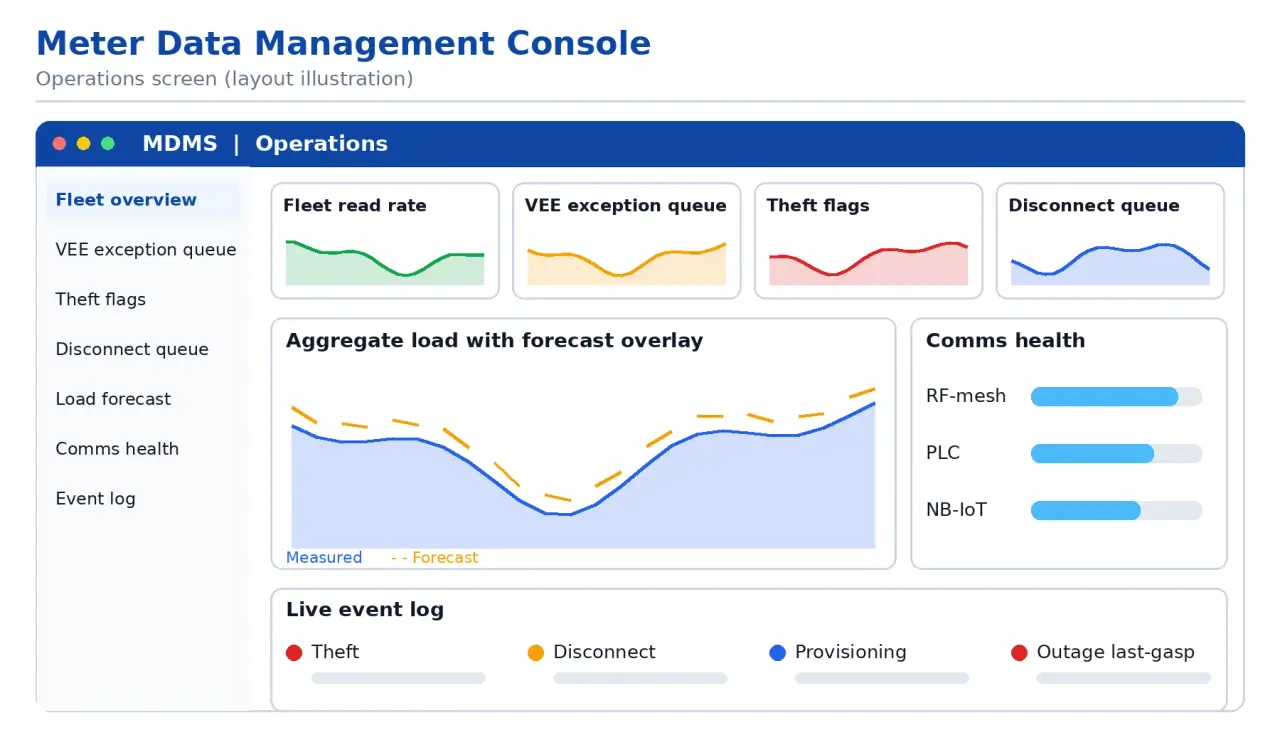
Meter Data Management Console
Unified view of fleet read rate, VEE exception queue, theft flags, disconnect queue, aggregate load with forecast overlay, comms health across RF-mesh/PLC/NB-IoT, and a live event log covering theft, disconnects, provisioning, and outage last-gasp.
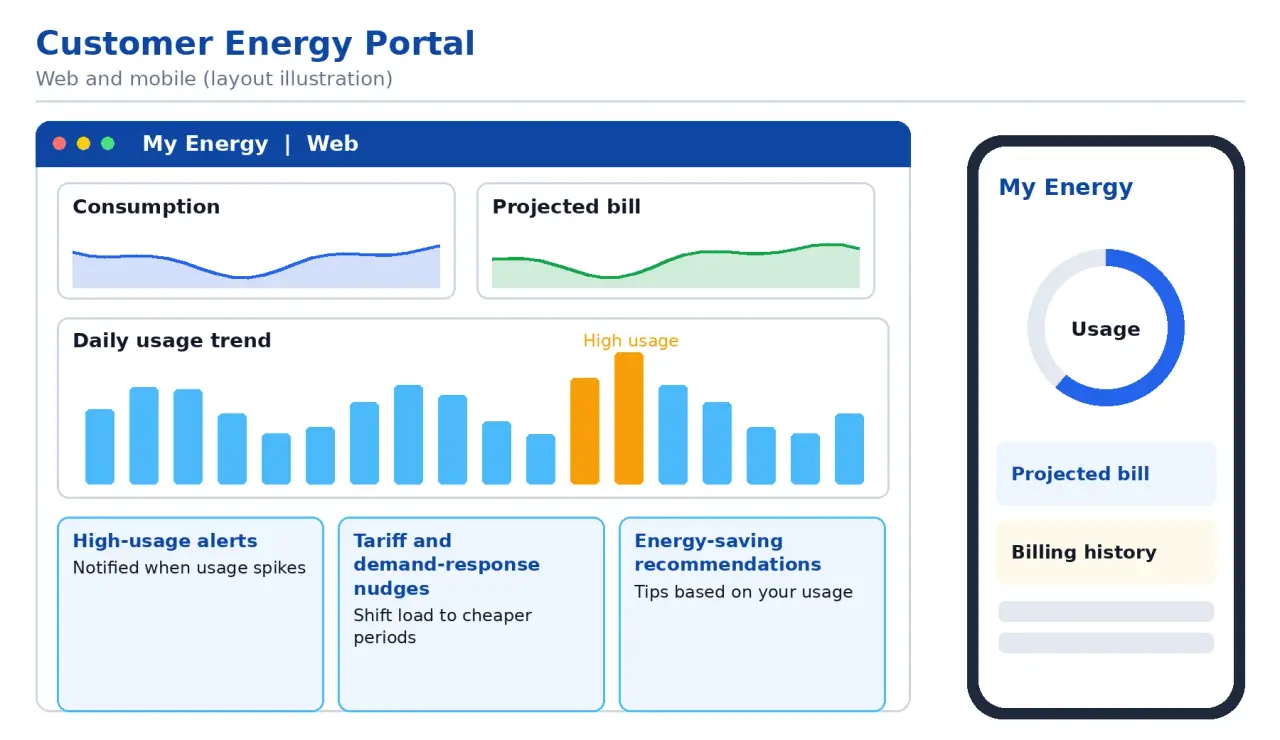
Customer Energy Portal
Consumption, projected bill, daily usage trend, high-usage alerts, tariff and demand-response nudges, energy-saving recommendations, and billing history across web and mobile.
Business Outcomes
Representative outcome targets delivered by the platform:
Additional benefits
- Reduced operational and maintenance cost through remote operations.
| Metric | Before | After |
|---|---|---|
| Meter reading | Manual, monthly | Automated, interval |
| Billing accuracy | Estimated, disputed | Actual, automated |
| Non-technical losses | Undetected | AI theft detection |
| Outage detection | Customer calls | Meter last-gasp |
| Connect / disconnect | Field visit | Remote, same-day |
| Demand management | No interval data | Forecast + DR |
| Customer engagement | Paper bill only | Web + mobile portal |
| System integration | Siloed | CIS/ERP/GIS/SCADA |
Technologies
Smart meters (electricity, water, gas); AMI communication networks (RF-mesh, PLC, NB-IoT, LTE, 5G); IoT gateways and edge computing; MQTT/Kafka; time-series databases; AI and machine learning; digital twins; GIS mapping; REST APIs and enterprise integration.
Industries
Electricity distribution companies, smart cities, industrial parks, commercial buildings, residential utilities, water utilities, gas distribution companies, campus energy management, and airports and metro networks.
Tech4Biz Differentiator
Tech4Biz is an R&D engineering company. We design and engineer custom AMI and smart metering platforms by combining smart meters, IoT communications, edge computing, cloud MDMS, AI, digital twins, and enterprise integration, helping utilities cut losses, bill accurately, engage customers, and modernize toward intelligent, sustainable energy systems.
Source
- Tech4Biz Showcase, collected on 26 November 2026.