AI-Driven Business Analytics for Free Cash Flow Optimization and Revenue Growth
Client Background Problem Statement Inaccurate Free Cash Flow Measurement : The finance team relied on traditional reporting methods, causing delays in cash flow insights and poor liquidity management. Revenue Leakage &a
| Showcase record | |
|---|---|
| Showcase category | Case studies |
| Industry | Cybersecurity & Infrastructure |
| Published | 15 March 2019 |
Key results
35% Faster Free Cash Flow Visibility : AI-enabled real-time tracking reduced reporting delays. 20% Reduction in Revenue Leakage : AI-driven anomaly detection prevented pricing and invoicing errors.

Client Background
Problem Statement
- Inaccurate Free Cash Flow Measurement: The finance team relied on traditional reporting methods, causing delays in cash flow insights and poor liquidity management.
- Revenue Leakage & Inefficiencies: High operational costs, manual invoicing errors, and misaligned pricing strategies affected net revenue.
- Delayed Decision-Making: Lack of real-time financial data prevented the leadership from proactively managing risks and optimizing working capital.
- Data Silos Across Departments: Disjointed finance, sales, and procurement data made it difficult to track cash flow trends and revenue performance holistically.

Suggested Solution
To address these challenges, an AI-powered business analytics platform was proposed to:
- Automate cash flow measurement with real-time data synchronization.
- Improve revenue forecasting using machine learning models.
- Optimize pricing strategies and cost control through AI-driven insights.
- Integrate financial data from multiple departments into a centralized dashboard for holistic decision-making.
Technical Implementation
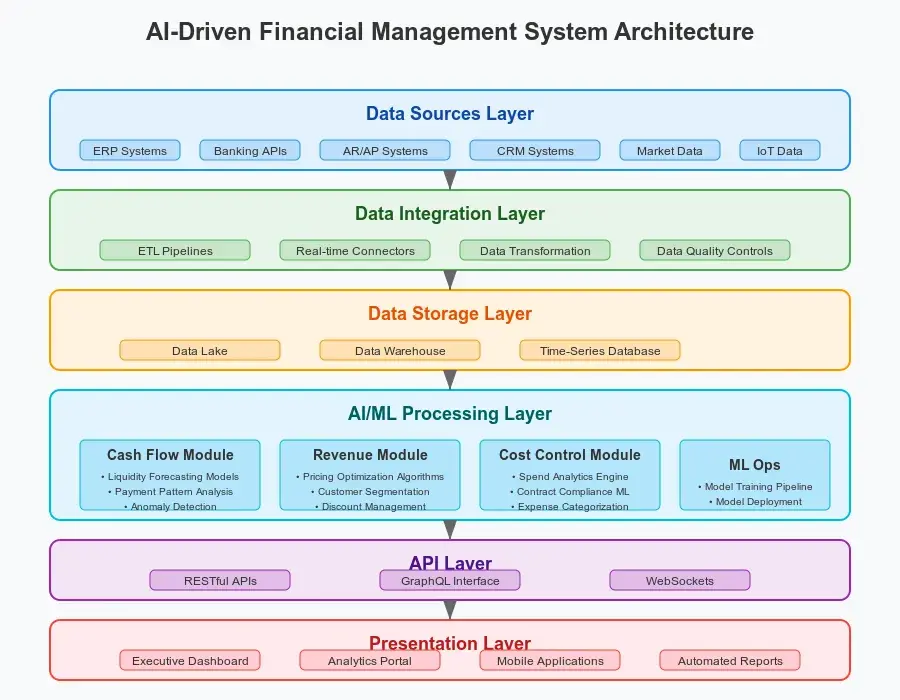
1. AI-Driven Free Cash Flow Measurement
- Integrated real-time transaction tracking from ERP systems, bank accounts, and accounts receivable/payable.
- Developed an AI-based liquidity forecasting model that analyzed historical payment patterns, supplier invoices, and revenue inflows.
- Implemented anomaly detection algorithms to flag unusual cash flow fluctuations or risks in payment cycles.
2. Revenue Optimization & AI-Based Pricing Strategy
- Used predictive analytics to identify optimal pricing for different product categories based on market trends and customer demand.
- Automated discount management to prevent unnecessary revenue loss while maintaining competitiveness.
- Introduced customer segmentation models to personalize pricing based on purchase behavior and profitability analysis.
3. Real-Time Executive Dashboard for Business Controlling
- Developed a cloud-based financial analytics dashboard integrating data from finance, procurement, and sales.
- Enabled real-time KPI monitoring for revenue, cash flow, working capital, and operational costs.
- Designed interactive drill-down reports for finance executives to analyze cash flow bottlenecks at granular levels.
4. AI-Powered Expense & Cost Control
- Used AI to analyze spending patterns and cost inefficiencies across procurement and operations.
- Integrated contract compliance monitoring to ensure vendors adhered to negotiated payment terms.
- Deployed automated expense categorization to streamline financial reporting and budgeting.
Challenges Encountered
- Data Integration Complexity: Financial data was spread across different ERP systems, requiring robust API connections and data transformation pipelines.
- Resistance to Change: Finance teams were initially reluctant to transition from traditional methods to AI-powered analytics.
- Ensuring Data Accuracy: AI models required clean and high-quality data for precise predictions, necessitating rigorous data validation.
- Real-Time Processing Demands: Handling large volumes of financial transactions in real time required scalable cloud infrastructure.

Client's Collaboration and Support in the Process
The client’s finance and IT teams actively participated in defining key financial metrics and integrating AI models with existing systems.
Senior leadership provided strong strategic alignment by advocating for data-driven financial decision-making.
Continuous feedback loops helped refine AI predictions and dashboard usability based on executive needs.
Benefits Realized
- 35% Faster Free Cash Flow Visibility: AI-enabled real-time tracking reduced reporting delays.
- 20% Reduction in Revenue Leakage: AI-driven anomaly detection prevented pricing and invoicing errors.
- Improved Working Capital Management: Optimized supplier payment cycles and cash reserves using AI-powered forecasting.
- 15% Increase in Net Revenue: AI-driven pricing strategies improved profit margins and customer retention.
- Automated 80% of Financial Reports: Manual finance team workload reduced, enabling focus on strategic planning.
Suggestions for the Future
- Enhancing AI Explainability: Implementing AI models with clearer decision-making rationale for better finance team adoption.
- Expanding Predictive Capabilities: Integrating AI with external economic indicators to improve revenue and cash flow forecasting accuracy.
- Automating Compliance & Risk Analysis: Using AI to continuously monitor tax regulations and audit readiness.
- Scaling to Multi-Currency & Global Operations
Source
- Tech4Biz Showcase, collected on 26 November 2026.