AI-Driven Digital Transformation for Business Decision-Making
Client Background Executives relied on fragmented data sources and manual reporting , leading to delayed decision-making and missed opportunities for revenue growth and cost optimization . The company aimed to leverage A
| Showcase record | |
|---|---|
| Showcase category | Case studies |
| Industry | AI, IoT & Emerging Technologies |
| Published | 10 May 2020 |
Key results
50% reduction in decision time, 20% cost reduction, 90% revenue forecasting accuracy

Client Background
Executives relied on fragmented data sources and manual reporting, leading to delayed decision-making and missed opportunities for revenue growth and cost optimization. The company aimed to leverage AI-powered solutions to streamline business intelligence, enhance financial forecasting, and enable a mobile-first approach for leadership decision-making.
Problem Statement
- Lack of Real-Time Insights
- Executives had to wait for periodic reports from different departments, delaying critical strategic decisions.
- Executives had to wait for periodic reports from different departments, delaying critical strategic decisions.
- Data Silos Across Departments
- Financial, sales, HR, and operational data were stored in separate systems, making it difficult to derive cross-functional insights.
- Financial, sales, HR, and operational data were stored in separate systems, making it difficult to derive cross-functional insights.
- Manual & Time-Consuming Reporting Processes
- Business analysts spent excessive time aggregating and formatting reports instead of deriving insights for leadership.
- Business analysts spent excessive time aggregating and formatting reports instead of deriving insights for leadership.
- Limited Mobility for Decision-Makers
- Executives lacked a mobile-friendly solution to monitor KPIs and get real-time alerts on business performance.
- Executives lacked a mobile-friendly solution to monitor KPIs and get real-time alerts on business performance.
- Inefficient Revenue Forecasting & Cost Control
- The absence of AI-driven predictive analytics led to suboptimal financial planning and revenue estimation errors.

Suggested Solution
The enterprise required a two-pronged AI-driven transformation strategy:
- An AI-Powered Mobile Application for executives to access real-time business insights anytime, anywhere.
- A Strategic AI-Driven Executive Insights Dashboard for cross-functional data integration and predictive analytics.
Detailed Technical Implementation
1. AI-Powered Mobile App for Business Leaders
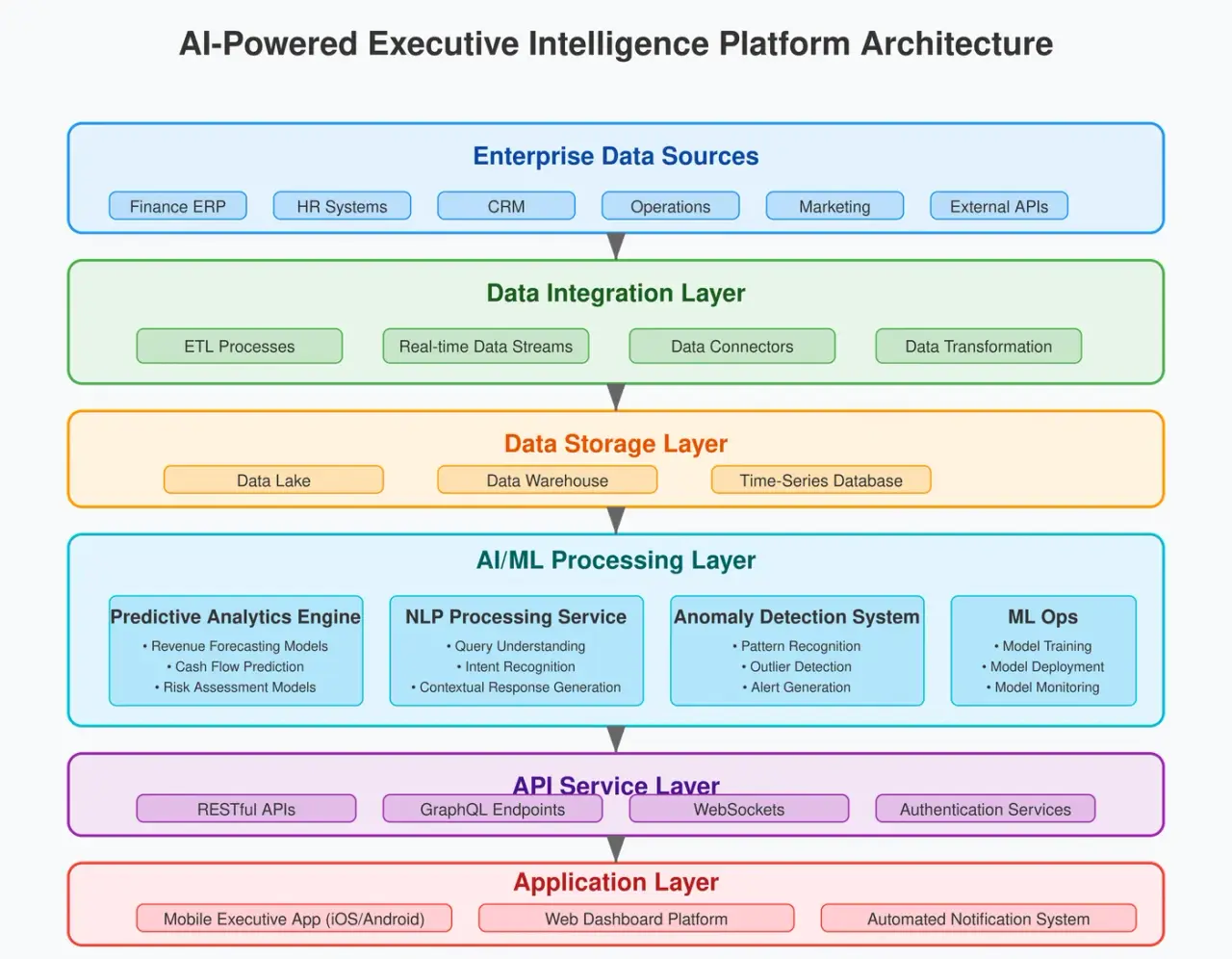
A custom-built AI-powered mobile application was developed to provide real-time, data-driven insights to executives. Key features included:
Real-Time Business Performance Tracking
- Live monitoring of revenue, cash flow, customer satisfaction, and operational efficiency metrics.
AI-Powered Predictive Analytics - Forecasting models to predict revenue growth, cash flow trends, and operational risks.
Natural Language Processing (NLP) for Query-Based Insights - Executives could ask AI-driven questions (e.g., “What is our revenue forecast for next quarter?”) and receive instant insights.
Anomaly Detection Alerts - AI flagged unusual patterns in sales, procurement, and operational expenses, helping leadership take preventive action.
2. Strategic AI-Driven Executive Insights Dashboard
To centralize and streamline decision-making, a comprehensive AI-powered dashboard was developed. It provided:
Dynamic Data Integration
- AI aggregated and harmonized data from finance, HR, sales, operations, and marketing, breaking departmental silos.
Advanced Predictive AI Models - Machine learning algorithms forecasted revenue, financial risks, supply chain disruptions, and operational performance.
Automated Insights & Recommendations - AI automated data analysis, delivering real-time, actionable insights without requiring manual intervention.
Cross-Functional Benchmarking - AI identified inefficiencies by comparing performance metrics across departments, helping optimize cost structures.
Challenges Encountered
Data Standardization Across Multiple Systems
- Integrating data from disparate ERP, CRM, and financial platforms required robust data transformation and AI harmonization.
Executive Adoption & Change Management - Leadership teams initially resisted transitioning to AI-powered decision-making, requiring hands-on training and support.
Ensuring Real-Time Data Accuracy - AI models required continuous fine-tuning to ensure accurate revenue forecasts, anomaly detection, and KPI tracking.
Scalability & Performance Optimization - Handling high volumes of enterprise data in real-time required cloud-based, high-performance computing solutions.

Client’s Collaboration and Support in the Process
Senior Leadership Buy-In: The company’s executives actively participated in defining critical business KPIs and data points.
Finance & Operations Team Engagement: Ensured smooth data integration and AI model validation.
Dedicated IT & AI Teams: Worked closely to deploy and optimize AI models in phases to reduce risks and improve accuracy.
User Training & Feedback Loops: Executives and analysts provided continuous feedback, refining AI-generated insights for better usability.
Benefits Realized
50% Reduction in Executive Decision Time
- AI-driven insights replaced manual reporting, leading to instant access to business-critical data.
20% Cost Reduction Through Predictive Analytics - AI-based revenue forecasting and expense optimization models helped cut inefficiencies.
90% Accuracy in Revenue Forecasting - AI-powered models improved financial planning, reducing forecasting errors from 30% to 10%.
Eliminated 80% of Manual Report Consolidation Work - Finance & operations teams shifted focus from data collection to strategic decision-making.
Enhanced Cross-Functional Collaboration - Centralized, AI-powered insights improved interdepartmental coordination and business alignment.
Suggestions for the Future
Enhancing AI Explainability & Transparency
- Implement AI models that provide clear justifications for financial forecasts and business recommendations.
Expanding AI-Driven Automation in Procurement & Compliance - Integrate AI-powered risk assessment tools for vendor selection and procurement management.
AI-Based Competitive Intelligence - Leverage AI to analyze industry trends, competitor benchmarks, and market positioning insights.
Integration with Generative AI for Advanced Analytics - Allow executives to generate AI-driven reports on demand, improving business intelligence capabilities.
ROI Calculation
| Metric | Before AI Implementation | After AI Implementation | Impact (%) |
|---|---|---|---|
| Decision-Making Speed | 2-3 Weeks Delay | Instant AI Insights | ↓ 50% Faster |
| Manual Report Consolidation | Hours/Days Per Report | AI-Driven Automation (Minutes) | ↓ 80% Reduction |
| Operational Costs | High Inefficiencies | 20% Cost Reduction | ↓ 20% |
| Revenue Forecasting Accuracy | ~70% Accuracy | 90% Accuracy with AI | ↑ 30% |
Conclusion
By integrating an AI-powered mobile application and a Strategic AI-Driven Executive Insights Dashboard, the client successfully transformed its executive decision-making process.
Faster, AI-driven decision-making enabled the leadership team to act proactively rather than reactively.
Data unification and predictive analytics optimized revenue management, operational costs, and business efficiency.
Improved agility and mobility empowered executives to monitor performance from anywhere, in real time.
This AI transformation positioned the company as an industry leader in data-driven executive decision-making, creating a competitive edge in today’s fast-paced business environment.
Source
- Tech4Biz Showcase, collected on 26 November 2026.