AI-Driven Optimization in Procurement, Sustainability, and Vendor Selection
Client Background The leadership sought an AI-powered solution to optimize supplier selection, improve sustainability tracking, and enhance procurement efficiency through data-driven insights. Problem Statement Inefficie
| Showcase record | |
|---|---|
| Showcase category | Case studies |
| Industry | Finance, Insurance & Business Transformation |
| Published | 17 August 2019 |
Key results
15% Reduction in Procurement Costs AI-driven cost optimization helped the company save millions annually. 20% Improvement in Vendor Selection Accuracy AI-based vendor scoring reduced supplier failures and improved product quality.

Client Background
The leadership sought an AI-powered solution to optimize supplier selection, improve sustainability tracking, and enhance procurement efficiency through data-driven insights.
Problem Statement
- Inefficient Vendor Selection Process
- The company relied on historical relationships rather than data-driven evaluation, leading to inconsistent supplier quality and high costs.
- The company relied on historical relationships rather than data-driven evaluation, leading to inconsistent supplier quality and high costs.
- Lack of Real-Time Procurement Insights
- Manual tracking of supplier performance, pricing fluctuations, and contract compliance led to delays in procurement decisions.
- Manual tracking of supplier performance, pricing fluctuations, and contract compliance led to delays in procurement decisions.
- Sustainability & ESG Compliance Challenges
- Growing regulatory pressures and corporate sustainability goals required improved tracking of supplier sustainability metrics.
- High Procurement Costs & Supply Chain Risks
- The inability to predict price fluctuations, demand surges, and supply chain disruptions increased operational risks.
- The inability to predict price fluctuations, demand surges, and supply chain disruptions increased operational risks.
- Fragmented Data Across Departments
- Procurement, finance, and operations worked in silos, lacking a centralized system for vendor evaluation and procurement efficiency tracking.

Suggested Solution
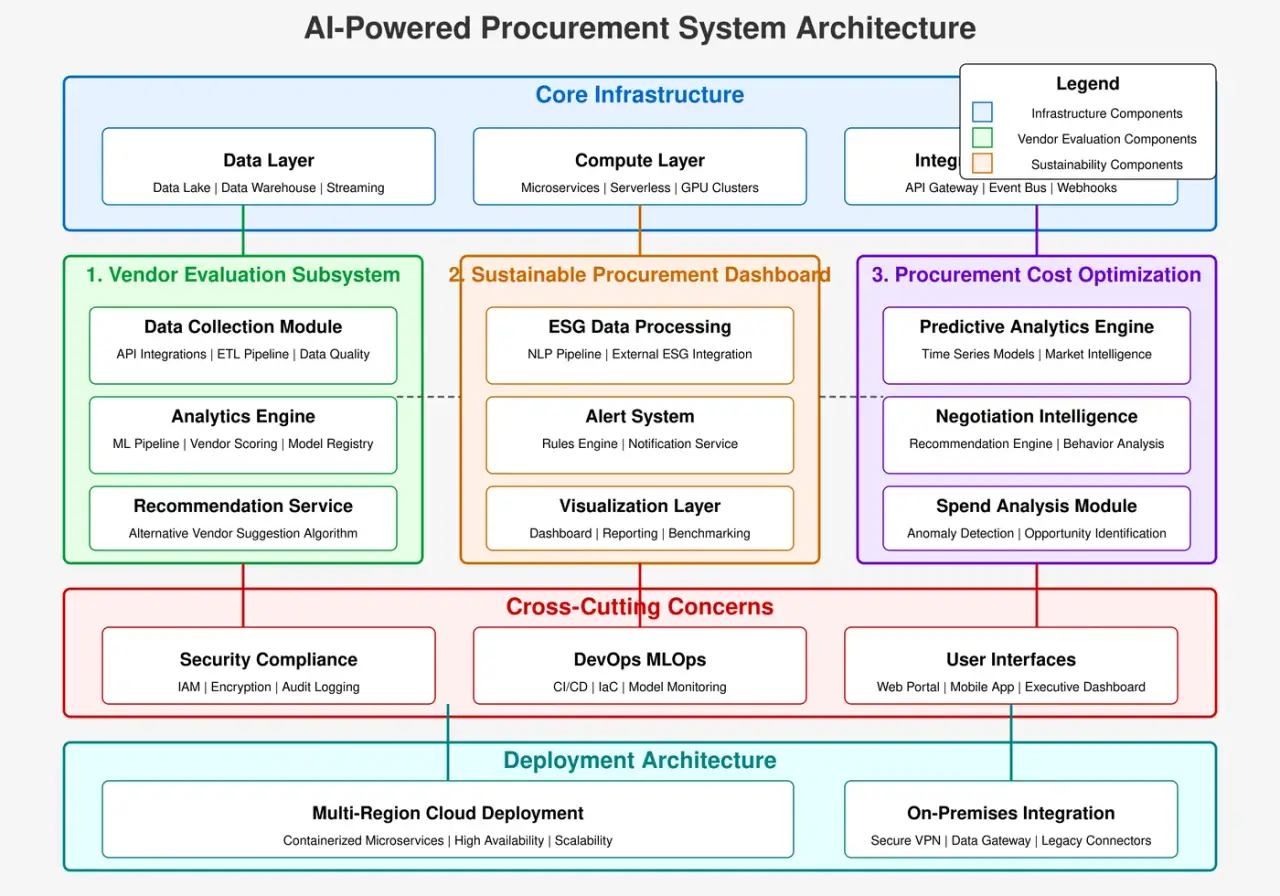
A three-tiered AI-powered system was implemented to address procurement inefficiencies, sustainability compliance, and vendor selection:
- AI-Powered Vendor Evaluation System
- Used AI to score suppliers based on quality, cost, risk, and sustainability parameters.
- Sustainable Procurement Dashboard
- AI-driven ESG (Environmental, Social, and Governance) compliance tracking to ensure vendors met sustainability standards.
- AI-Based Procurement Cost Optimization
- Machine learning models to forecast pricing trends, detect cost-saving opportunities, and prevent supply chain risks.
Detailed Technical Implementation
1. AI-Powered Vendor Evaluation System
Supplier Data Aggregation & Risk Assessment
- AI aggregated vendor performance data from procurement records, audits, and external sources.
- Machine learning models assessed supplier reliability, defect rates, on-time deliveries, and pricing consistency.
AI-Driven Vendor Scoring Model - AI assigned real-time scores to vendors based on quality, cost-effectiveness, and risk assessment.
- Vendors with lower sustainability ratings were flagged for compliance improvements.
Dynamic Supplier Selection - AI suggested alternative vendors with better performance metrics to reduce dependency on underperforming suppliers.
2. Sustainable Procurement Dashboard
Real-Time ESG Compliance Monitoring
- AI analyzed supplier sustainability practices, tracking carbon footprint, waste management, and ethical sourcing compliance.
Automated Risk Alerts - If a supplier violated environmental regulations or human rights policies, AI triggered alerts for immediate corrective action.
Sustainability Performance Benchmarking - AI compared suppliers’ ESG compliance levels to industry benchmarks, helping the company align with sustainability goals.
3. AI-Based Procurement Cost Optimization
Predictive Analytics for Procurement Pricing
- AI analyzed historical price trends and global market conditions to predict cost fluctuations.
Automated Contract Negotiation Insights - AI recommended negotiation strategies based on past supplier behavior and industry pricing benchmarks.
Real-Time Spend Analysis & Cost Reduction Suggestions - AI identified overpricing, inefficiencies, and bulk purchasing opportunities to cut procurement costs.

Challenges Encountered
Data Integration Across Multiple Systems
- Procurement data resided in separate ERP, finance, and supplier management systems, requiring custom AI-driven data pipelines.
Resistance to AI-Based Vendor Selection - Procurement teams were accustomed to manual vendor selection, requiring change management efforts and training.
Ensuring AI Fairness & Bias-Free Supplier Evaluation - AI models had to be carefully trained to avoid bias against new suppliers while still prioritizing performance and sustainability.
Real-Time Market Volatility Adaptation - AI models needed continuous updates to handle unexpected supply chain disruptions and global pricing fluctuations.

Client’s Collaboration and Support in the Process
Executive Leadership Buy-In: The C-suite supported AI-driven procurement to reduce costs and meet sustainability goals.
Procurement & ESG Teams Engagement: Procurement and compliance teams provided real-world supplier performance insights to fine-tune AI models.
Vendor Training & Engagement: Suppliers were educated on AI-based evaluation criteria, ensuring fair competition.
Benefits Realized
15% Reduction in Procurement Costs
- AI-driven cost optimization helped the company save millions annually.
20% Improvement in Vendor Selection Accuracy - AI-based vendor scoring reduced supplier failures and improved product quality.
30% Increase in ESG-Compliant Vendor Contracts - The company significantly improved sustainability compliance, reducing environmental risks.
50% Faster Procurement Decision-Making - AI-enabled insights replaced manual vendor evaluation, accelerating supplier selection.
Lowered Supply Chain Disruptions by 40% - AI’s predictive analytics helped prevent supplier shortages and stockout risks.
Suggestions for the Future
AI-Driven Dynamic Pricing Negotiation
- Implement real-time AI negotiation tools for supplier contract optimization.
Blockchain for Supplier Transparency - Integrate blockchain-based vendor tracking for supply chain transparency and fraud prevention.
AI-Based Automated Purchase Order Recommendations - Allow AI to suggest purchase order optimizations based on real-time demand forecasting.
Expansion to Global Supplier Networks - Use AI to analyze international supplier markets for better sourcing options.
ROI Calculation
| Metric | Before AI Implementation | After AI Implementation | Impact (%) |
|---|---|---|---|
| Procurement Costs | High due to inefficiencies | Reduced by 15% | -15% Reduction |
| Vendor Selection Accuracy | 75% (manual evaluation) | 95% (AI-driven selection) | +20% Increase |
| Supply Chain Disruptions | Frequent due to poor insights | Reduced by 40% | -40% Disruptions |
| Sustainability Compliance | 60% vendors ESG-compliant | 90% vendors ESG-compliant | +30% Compliance |
| Procurement Decision Time | 4-6 weeks (manual) | 1-2 weeks (AI-assisted) | 50% Faster Decisions |
Conclusion
By leveraging AI-driven procurement optimization, vendor selection, and sustainability tracking, the client transformed its supply chain efficiency, reduced procurement costs, and ensured ESG compliance.
The AI-powered system provided real-time insights, automated supplier evaluation, and enabled proactive cost-saving strategies. As a result, the organization achieved smoother supply chain operations, improved vendor relationships, and long-term financial sustainability.
This case study demonstrates how AI can revolutionize procurement and sustainability efforts, helping enterprises achieve greater efficiency, cost control, and corporate responsibility.
Source
- Tech4Biz Showcase, collected on 26 November 2026.