On-Vehicle Voice & Diagnostic Assistant
This study describes an assistant inside the vehicle that explains faults to the driver in plain speech, without a network connection and without data leaving the vehicle.
| Showcase record | |
|---|---|
| Showcase category | Case studies |
| Industry | Automotive |
| Published | 5 August 2026 |
This study describes an assistant inside the vehicle that explains faults to the driver in plain speech, without a network connection and without data leaving the vehicle.
At a glance
| The problem | A vehicle records thousands of diagnostic events, but the driver sees only a warning lamp or a short message. |
| The approach | An edge node reads live vehicle data, retrieves the manufacturer's documentation from local storage and answers by voice. It explains and recommends only; it controls no vehicle function. |
| Technology | AMD Kria KR260, CAN, CAN-FD, LIN and OBD-II data, local retrieval and a 4-bit quantized language model. |
| Measures and results | The study defines pilot measures such as time to explanation and avoided workshop visits. It reports no measured results. |
The Business Problem
What the vehicle already knows
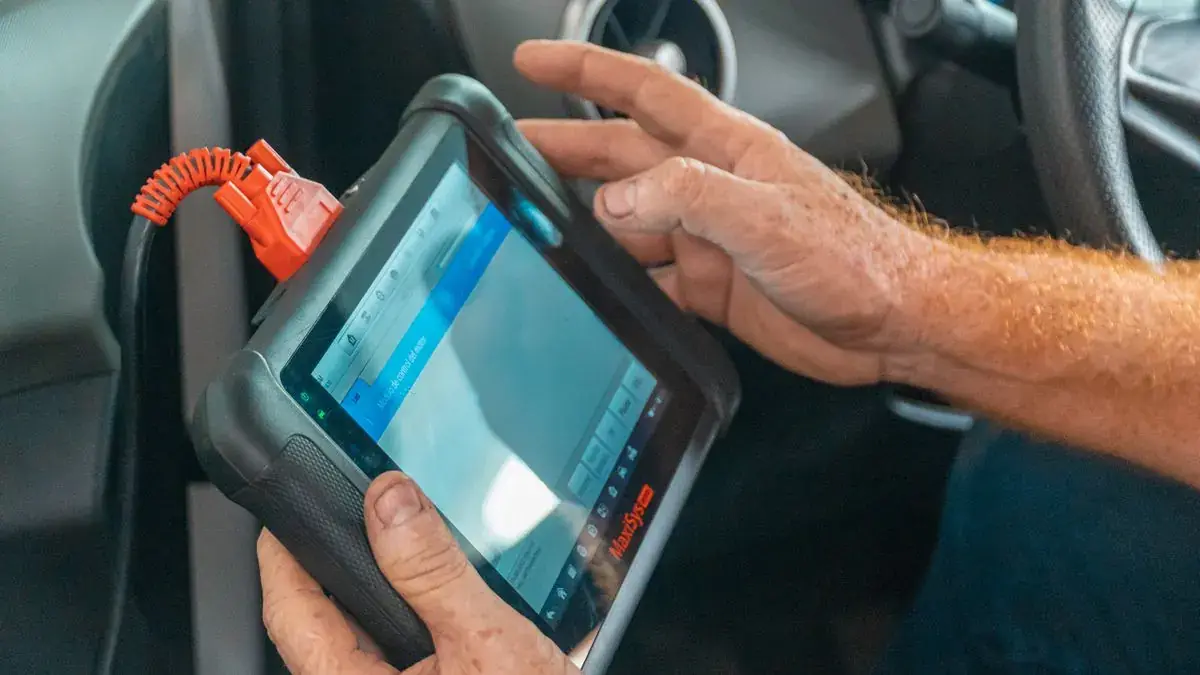
A modern passenger or commercial vehicle produces thousands of diagnostic events every journey. Powertrain, chassis, body and ADAS controllers exchange messages across CAN and CAN-FD, legacy comfort functions sit on LIN, and the emissions related subset is exposed through the OBD-II port.
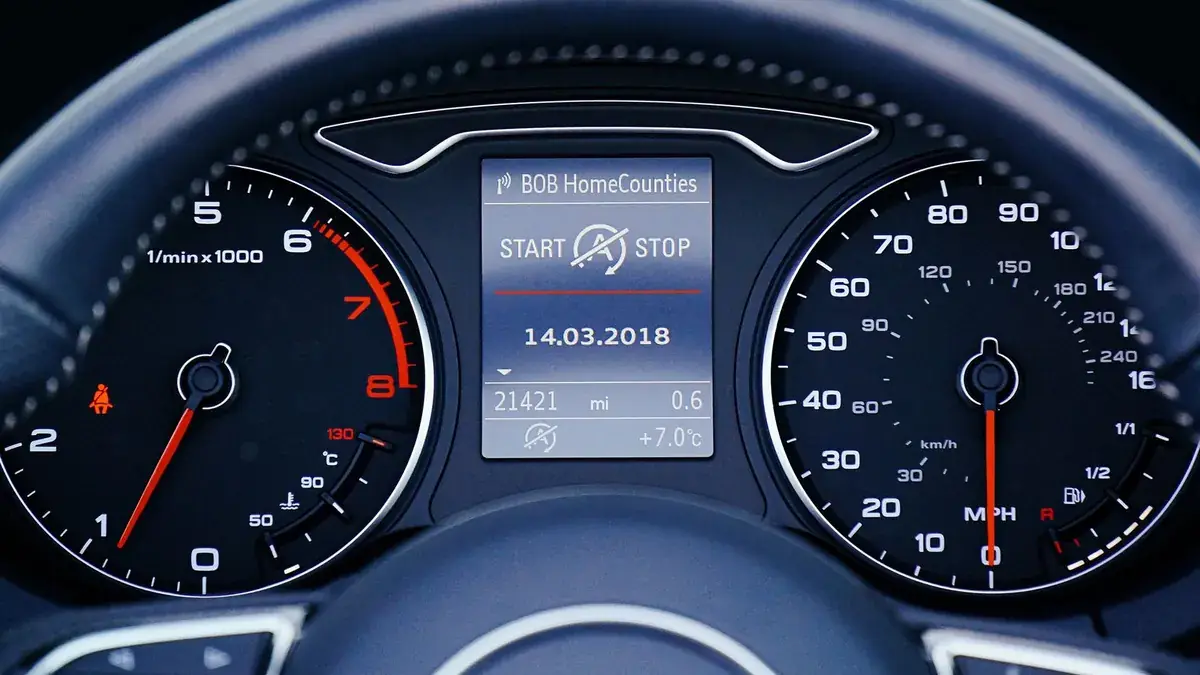
Fault memory, freeze frame data, readiness monitors and live sensor values are all present. Almost none of that reaches the person driving. The driver gets a lamp on the cluster and, at best, a three word message. The interpretation happens later, at a workshop, using a diagnostic tool and a technician who was not there when the fault occurred.
Why cloud assistants do not solve it
The connected assistants deployed today push the question and often the vehicle context to a
backend. That introduces four problems at once.
- Latency. A round trip over a mobile network adds hundreds of milliseconds before the model even
starts generating, and the variance is worse than the average. - Availability. Underground car parks, tunnels, rural roads, ferries and border crossings all break the
feature at exactly the moment a driver is most likely to need it. - Privacy and residency. Vehicle identification, location, driving behaviour and fault history are personal
data in most jurisdictions once they are linked to a person. - Recurring cost. Per query inference billed to the OEM for the life of the vehicle is a liability that grows
with fleet size and with feature success.
The cost of the status quo
| Where the cost sits | What actually happens |
|---|---|
| Driver | Uncertainty about whether the vehicle is safe to keep driving, leading to either unnecessary alarm or ignored warnings. |
| Dealer network | Diagnostic time consumed on faults that were self explanatory, and no-fault-found visits that carry full labour cost. |
| Roadside assistance | Callouts for conditions that did not require a callout. |
| Warranty | Late intervention on faults that degrade into more expensive failures. |
| Fleet operator | Vehicles taken off route on precaution rather than on evidence. |
| OEM brand | The warning lamp remains the least understood interface in the car. |
The requirement in one sentence
Explain vehicle state to the driver, in natural language, at the moment the fault appears, grounded in the manufacturer's own documentation, with no dependency on a network and no data leaving the vehicle.
Why now
Two things changed. Small language models in the three to four billion parameter range became genuinely capable at instruction following and summarisation, and quantization matured to the point where those models fit the memory budget of an automotive grade system on module. The reasoning layer can finally sit next to the bus it is reasoning about.
Solution Overview
The assistant is a single edge node on the vehicle network. It listens, reads live vehicle state, retrieves the relevant manufacturer documentation from local storage, reasons over all three, and speaks the answer back. Every stage runs on the AMD Kria KR260
Layered architecture
| Layer 6 Interaction | Voice in, voice out | Beamformed microphone array, wake word, text to speech through the cabin audio path. |
| Layer 5 Reasoning | 4-bit quantized language model | Instruction tuned small model, constrained to answer only from retrieved and observed facts. |
| Layer 4 Knowledge | Local retrieval index | Service manuals, DTC reference, repair procedures, vehicle specific history. |
| Layer 3 Vehicle state | CAN and OBD-II decode | DBC driven signal decode, UDS fault memory read, freeze frame capture. |
| Layer 2 Acceleration | Programmable fabric and DPU | Dequantization, matrix operations and audio pre-processing offloaded from the CPU cores. |
| Layer 1 Platform | Kria K26 SoM on KR260 carrier | Zynq UltraScale+ MPSoC, on-module DDR4, local NVMe or eMMC. |
Design principles
| Principle | How it is enforced |
|---|---|
| Read only on the bus | The CAN transceiver is configured listen only. The assistant physically cannot transmit a frame onto the vehicle network. |
| Grounded answers only | The model answers from retrieved document text and decoded signals. If neither supports an answer it says so rather than generating one. |
| No egress | There is no outbound data path in the reference design. Audio, faults and location never leave the node. |
| Deterministic core untouched | All safety relevant behaviour stays in existing ECU software. The assistant is an explanation layer, not a control function. |
| Bounded memory | Every component has a fixed memory allocation. There is no dynamic growth path that can exhaust the module under load. |
| Signed everything | Model weights, retrieval index and application image are all signature verified before they are allowed to load. |
What this is not
This is not a voice control system and it does not command any vehicle function. It reads, explains and recommends. That boundary is what keeps the homologation and functional safety argument simple.
Hardware Architecture
Compute platform
The AMD Kria KR260 robotics starter kit carries the K26 system on module. The KR260 is chosen over the KV260 because the carrier already exposes the Ethernet, PMOD and general interfaces that vehicle and industrial integration needs, rather than a vision oriented interface set.
| Element | Configuration |
|---|---|
| System on module | Kria K26, Zynq UltraScale+ MPSoC |
| Application processors | Quad core Arm Cortex-A53 |
| Real time processors | Dual core Arm Cortex-R5F |
| Programmable logic | On-module FPGA fabric with BRAM and URAM |
| On-module memory | 4 GB DDR4 with ECC support |
| Local storage | NVMe or eMMC, sized for model plus retrieval corpus |
| Boot | Secure boot chain with on-module non volatile storage |
Vehicle side peripherals
CAN / CAN-FD transceiver (listen only)
OBD-II J1962 harness
LIN transceiver (optional)
Automotive Ethernet (optional)
Operator station
Four element MEMS microphone array
Hardware acoustic echo cancellation
Class-D amplifier or head unit audio path
Push to talk input (optional)
Power and thermal
The node is designed to run from switched vehicle 12 V through an automotive grade DC-DC stage with load dump and reverse polarity protection. Thermal design is the constraint that usually decides real world throughput, so it is treated as a first class requirement rather than a packaging afterthought.
- Sustained rather than peak performance is the design point. The assistant must hold its token rate through a full duty cycle at cabin ambient, not just for the first thirty seconds on a bench.
- Conducted cooling to the enclosure is preferred over fans in a cabin installation, for noise and for long term reliability.
- Thermal throttling behaviour is characterised and the model scheduler is made aware of it, so degradation is graceful rather than abrupt.
- Cold start behaviour at low ambient is validated separately, since DDR and storage timing both shift
Integration decision to take early
Whether the node is a standalone aftermarket module on the OBD-II port or an integrated function on an existing domain controller changes the harness, the thermal envelope and the homologation path. This decision should be taken before detailed design, not after.
Vehicle Interface and Signal Decode
Protocol coverage
| Interface | Purpose in this architecture |
|---|---|
| CAN 2.0B and CAN-FD | Live signal observation across powertrain, chassis and body networks at production bus rates. |
| ISO 15765-2 | Transport layer for segmented diagnostic messages. |
| UDS, ISO 14229 | Fault memory read, freeze frame retrieval and data identifier reads where the OEM permits them. |
| OBD-II | Emissions related fault codes, live data, readiness monitors and the standardised subset available on every vehicle. |
| LIN | Comfort and body subsystems where the fault is relevant to the driver. |
| DBC or ARXML | Signal database that turns raw frames into named, scaled, unit-bearing values. |
From frame to fact
Raw CAN traffic is useless to a language model. The decode stage converts it into a compact, typed vehicle state object that the reasoning layer can be given directly, with names and units the documentation also uses.
Vehicle state object
Why the snapshot reference is in the plan
Recording which world model snapshot the plan was built against makes the whole decision reproducible after the fact. When something goes wrong on a floor, the first question is always what the system believed at the time, and this answers it exactly.
Rate and buffering
- High rate signals are decimated and windowed at the decode stage, not at the model.
- A rolling buffer retains the seconds before a fault so freeze frame context is available even when the driver asks
a minute later. - Bus load is unaffected because the node never transmits.
Speech Front End and Response Path
Capture
Cabin audio is a harder problem than the model. Road noise, HVAC, wind, music and passengers all sit in the same band as speech, and the microphone is rarely where you would want it.
| 01 | Microphone array capture at 16 kHz | Multi element MEMS array positioned for the driver seat. |
| 02 | Beamforming and acoustic echo cancellation | Steered toward the driver, with the vehicle's own audio output subtracted. |
| 03 | Noise suppression and voice activity detection | Runs on the fabric so the application cores stay free for inference. |
| 04 | Wake word or push to talk gate | Nothing is transcribed or retained until the gate opens. |
| 05 | Whisper Tiny or DistilWhisper transcription | Quantized to int8, running on device, audio discarded immediately after. |
Response
The generated answer is spoken back through Piper TTS or Coqui TTS, streamed as it is produced rather than synthesised after the full answer is complete. Streaming matters more than raw token rate for how fast the system feels, because the driver hears the first words while the rest is still generating.
| Stage | Design target |
|---|---|
| Wake to transcript | Complete before the driver finishes the sentence. |
| Vehicle state assembly | Read from the rolling buffer, no bus query needed. |
| Retrieval | Local index lookup, no network. |
| First spoken syllable | Sub second from end of utterance. |
| Full answer | Streamed continuously, no audible gap. |
Status of figures
These are design targets for the reference configuration. They are confirmed on the customer hardware, cabin acoustics and duty cycle during the engineering phase, and the validated numbers replace them in the delivered specification.
Privacy posture
- Audio is never written to persistent storage.
- Transcripts exist only for the duration of the interaction unless the operator explicitly enables a diagnostic log,which is off by default.
- There is no outbound network path in the reference design, so there is nothing to intercept.
Inference Stack and Memory Budget
Why four bit
A three billion parameter model at sixteen bit precision needs roughly six gigabytes for weights alone. The module has four. At four bit the same model comes down to approximately 1.7 gigabytes, which leaves working room for the key value cache, the speech models, the retrieval index and the operating
system.
The second effect matters more. Generating each token requires streaming the entire weight set out of DDR, so throughput is bound by memory bandwidth rather than by arithmetic. Halving the bytes per weight roughly doubles the achievable token rate.
Quantization approach
| Planner responsibility | What it checks |
|---|---|
| Dependency ordering | Precedence expressed in the instruction is turned into an acyclic task graph and validated. |
| Feasibility | Is there a robot of the right type, free within the window, able to reach both locations. |
| Battery and duty | Does the assigned robot have enough charge for the full task chain plus a return margin. |
| Zone and access rules | Are all traversals and all destinations permitted for this robot type at this time. |
| Capacity | Does the destination have space, and is the load within payload limits. |
| Conflict | Does this plan contend with an already dispatched plan for the same robot, load or location. |
Indicative memory budget
| Choice | Rationale |
|---|---|
| Group-wise 4-bit | Per-group scales preserve accuracy far better than a single tensor-wide scale, at negligible memory cost. |
| GPTQ or AWQ | Calibration on representative automotive text keeps the quality loss concentrated away from the domain that matters. |
| Sensitive layers kept wider | Embeddings and the output head carry disproportionate error, so they are held at higher precision. |
| Domain evaluation set | Accuracy is measured on decoded fault scenarios and manual questions, not on generic benchmarks. |
Arbitration stays with the fleet manager
The planner proposes. The existing fleet manager remains the single authority that dispatches, sequences against other traffic and resolves contention. Introducing a second scheduler would be the fastest way to create deadlock on a live floor, so the architecture deliberately avoids it.
Context discipline
Context length is a memory decision, not a convenience. The key value cache grows linearly with context and competes directly with the weights for bandwidth. The design uses a short working context, aggressive retrieval rather than long prompts, and a fixed cap that cannot be exceeded at runtime.
The DDR Pipeline
This is where the engineering effort actually goes. Theoretical bandwidth on the module is a ceiling nobody reaches, and the gap between theoretical and achieved bandwidth is the single largest determinant of how the system performs in a vehicle
The constraint
Every generated token requires the full weight set to cross the memory bus once. The upper bound on token rate is therefore achievable bandwidth divided by model bytes, and no amount of compute
optimisation moves it. Everything below is aimed at raising the achievable fraction.
Optimisation techniques applied
| Tiling | Weight matrices tiled to on-chip memory | Tile geometry chosen against available BRAM and URAM rather than against the model shape. |
| Double buffering | Transfer overlapped with compute | One tile is processed while the next streams in over AXI, so the accelerator never waits. |
| Prefetch | Next layer fetched during current layer | Layer boundaries are the most common stall point and are eliminated deliberately. |
| On-fabric dequant | Four bit bytes cross the bus | Dequantization happens after transfer, not before, so the bus carries the compressed form. |
| Burst alignment | Access patterns matched to DDR pages | Row activation and refresh overhead is minimised by laying weights out for sequential access. |
What goes wrong when this is skipped
| Symptom | Usual root cause |
|---|---|
| Token rate far below estimate | Dequantization on the processor side, so sixteen bit values are crossing the bus. |
| Throughput collapses with context | Key value cache traffic contending with weight streaming for the same bandwidth. |
| High variance between runs | Unaligned access patterns causing DDR row thrash. |
| Accelerator utilisation low | No double buffering, so compute idles during every transfer. |
| Good bench, poor vehicle | Thermal throttling not characterised, so sustained performance was never measured. |
Fabric offload beyond memory movement
The programmable logic is also used for the audio front end, for the vision path where one is present, and for matrix operations that map cleanly to the DPU. The objective is to keep the application cores free for orchestration and decode, rather than to have them competing with the model for the same resources.
Measurement discipline
- Achieved bandwidth is measured directly, not inferred from token rate.
- Sustained performance is reported over a full duty cycle, never as a peak figure.
- Every quoted number carries the model, quantization scheme, context length and ambient temperature it was
obtained at.
Knowledge Layer and Grounding
Corpus
The assistant answers from the manufacturer’s own material, held on local storage and versioned against the vehicle build. Nothing is answered from model parameters alone.
Service and workshop manuals
Diagnostic trouble code reference
Repair procedures and labour guides
Owner handbook
Technical service bulletins
Vehicle specific repair history
Ingestion pipeline
| 01 | Layout aware document parsing | Tables, torque specifications and procedure steps preserved as structure, not flattened text. |
| 02 | Section anchored chunking | Chunks follow document sections so a citation points somewhere a technician can find. |
| 03 | Embedding and index build | Compact sentence embeddings, index built offline at release time rather than on the vehicle. |
| 04 | Hybrid retrieval | Dense similarity combined with keyword matching, because fault codes are exact strings. |
Grounding policy
The reasoning layer operates under a strict contract. It may use the decoded vehicle state and the retrieved document text. It may not use anything else.
| Situation | Required behaviour |
|---|---|
| Retrieval returns strong match | Answer, and internally record which section was used. |
| Retrieval is weak or empty | State that the vehicle documentation does not cover the question and recommend contacting service. |
| Question outside scope | Decline and redirect, rather than improvising. |
| Fault is safety relevant | Give the manufacturer's stated instruction verbatim in substance, and do not soften it. |
| Conflicting sources | Prefer the newest technical service bulletin and say that guidance was updated. |
Version pinning
The retrieval corpus is pinned to the vehicle build. A manual that describes a different variant is worse than no manual, so corpus version, model version and application version are released and updated as one signed bundle.
Evaluation
Answer quality is measured against a fixed regression set of decoded fault scenarios with known correct guidance, refreshed whenever the corpus or the model changes. Retrieval accuracy and answer faithfulness are scored separately, because they fail for different reasons and need different fixes.
Worked Example, End to End
Driver
“My engine light is on.”
Step 1 Capture
Utterance transcribed on device
Beamformed, echo cancelled, transcribed by Whisper Tiny. Audio discarded.
Step 2 Vehicle state
P0420 confirmed, bank 1
Read from the rolling buffer with freeze frame at the moment of detection.
Step 3 Retrieval
Three grounded sources returned
DTC reference entry, catalytic converter section of the service manual, and two prior occurrences from this vehicle's own history.
Step 4 Reasoning
Severity action derived
Catalyst efficiency below threshold, emissions related, not immobilising, service recommended within a bounded distance.
Step 5 Response
Streamed to the cabin speaker
Speech synthesis begins before generation completes.
Assistant
“Your vehicle has detected reduced catalytic converter efficiency. Driving is safe for short distances, but service is recommended within 150 kilometres. This is the third time this fault has appeared, so it is worth mentioning at your next visit.”
Follow up handling
| Driver | “Can I still drive to Chennai tomorrow?” |
| Assistant | “That distance is beyond the recommended service interval for this fault. The vehicle will drive, but emissions performance is degraded and continued driving may affect other components. I would have it checked before a long journey.” |
| What made the second answer possible | Conversational context is retained locally for the duration of the session. The assistant did not re-read the bus or re-run retrieval. It reasoned over state it already held, which is why the follow up is faster than the first answer. |
Safety, Security and Homologation
Functional safety position
The assistant is deliberately kept outside the safety path. It observes and explains. It does not actuate, it does not command, and it does not suppress or modify any existing warning
| Aspect | Position |
|---|---|
| Bus access | Listen only at the transceiver, enforced in hardware. |
| Existing warnings | Unchanged. The cluster behaves exactly as it does today. |
| Classification | Treated as a quality managed item, outside the ASIL decomposition, subject to confirmation with the OEM safety team. |
| Failure mode | Silence. If the assistant fails, the driver is exactly where they would have been without it. |
| Driver distraction | Voice first interaction, assessed against the applicable distraction guidelines for the target market. |
Cybersecurity
Even with no outbound path, the node is an attached device on a vehicle network and is treated as part of the attack surface.
- Secure boot from the on-module root of trust, with signature verification at every stage.
- Model weights and retrieval index signed and verified before load, so a tampered corpus cannot change what the assistant tells the driver.
- Update path aligned to UNECE R156 software update management expectations.
- Threat analysis and risk assessment aligned to UNECE R155 and ISO/SAE 21434, carried out against the specific vehicle architecture.
- No inbound remote interface in the reference design. Servicing is physical or through the OEM’s existing authenticated update channel.
Long term consideration
A vehicle stays on the road for fifteen years or more. Signatures applied today have to remain trustworthy for that whole period, which is why hash based or lattice based post quantum signing of model and corpus artefacts is worth designing in now rather than retrofitting later.
Deployment and Lifecycle
Release bundle
Model, retrieval corpus and application are released together as one signed bundle with a single version number. Mixing versions is the most common way an on-device assistant starts giving wrong answers, so the design removes the possibility.
| Build | Quantize, index, evaluate, sign | Regression set must pass before a bundle is eligible for release. |
| Distribute | Existing OEM update channel | No new backend is introduced. The bundle rides what the OEM already operates. |
| Install | A/B partition with verification | The new bundle is verified before it becomes active. |
| Rollback | Automatic on failed health check | The previous known good bundle is retained until the new one has proven itself. |
Fleet observability without data egress
Quality has to be monitored without shipping conversations off the vehicle. The design uses aggregate, non-identifying counters read at service, such as refusal rate, retrieval miss rate and interaction counts by fault family. These indicate where the corpus is thin without exposing what any driver said.
Delievery phases
| Phase | Scope | Exit criteria |
|---|---|---|
|
Phase 0 Assessment |
Vehicle architecture review, bus access and DBC availability, corpus audit, target variant selection. | Agreed reference configuration and integration decision. |
|
Phase 1 Bench prototype |
Model quantized and characterised on KR260, decode stack against recorded bus traces, retrieval built on real manuals. | Measured token rate, memory footprint and thermal envelope on the bench. |
|
Phase 2 In-vehicle pilot |
Installed in target vehicles, cabin acoustics tuned, duty cycle and thermal behaviour validated in use. | Sustained performance and answer quality against the regression set in the vehicle. |
|
Phase 3 Productionisation |
Security case, update path, homologation support, manufacturing and service documentation. | Release candidate bundle and signed off security assessment. |
|
Phase 4 Fleet rollout |
Staged deployment with rollback, corpus expansion by variant and market. | Agreed field quality thresholds held over the rollout window. |
Benefits and Measurement
Benefits realised
| Offline operation | Full function in tunnels, underground parking, remote roads and any market without reliable coverage. |
| Sub second response | No cloud round trip anywhere in the critical path, and no variance from network conditions. |
| No customer data leakage | Audio, faults, location and driving behaviour never leave the vehicle boundary. |
| Real time diagnostics | Explanation delivered at the moment the fault appears, with freeze frame context intact. |
| Lower support load | Fewer avoidable dealer visits and roadside callouts for self explanatory conditions. |
| Predictable cost | Inference cost is capital, not a per query operating charge that scales with fleet size. |
| Regulatory headroom | On device processing simplifies the data residency and privacy position in every market. |
| Brand differentiation | The warning lamp stops being the least understood interface in the car. |
KPI framework
These are the measures worth instrumenting from the pilot onward, because they are the ones a sponsor will be asked about.
| Measure | What it tells you |
|---|---|
| Containment rate | Share of driver questions answered without a service contact. |
| Time to explanation | Interval between fault detection and the driver understanding it. |
| Refusal rate | How often the corpus does not cover the question, which is the main signal for where to expand it. |
| Retrieval miss rate | Whether the index or the corpus is the weak link. |
| No-fault-found visits | Direct dealer cost avoided. |
| Roadside callout rate | Direct assistance cost avoided. |
| Sustained token rate | Whether the thermal design is holding in the field. |
Baseline first
Every one of these needs a pre-deployment baseline. Without it the pilot will produce numbers that cannot be defended, which is the most common reason a technically successful edge pilot fails to get funded into production.
Engineering Considerations and Risks
Known hard problems
| Risk | Mitigation |
|---|---|
| Thermal ceiling in cabin ambient | Characterise sustained rather than peak performance early, and design the enclosure for conducted cooling before software optimisation begins. |
| Corpus and build drift | Single signed bundle with one version number covering model, corpus and application. |
| Ungrounded generation | Strict retrieval contract, explicit refusal path, and a regression set that specifically tests refusal behaviour. |
| Bus access restrictions | Confirm DBC or ARXML availability and permitted UDS services with the OEM in Phase 0, before any design commitment. |
| Cabin acoustics | Microphone placement and beamforming tuned per vehicle model, not carried over from a reference cabin. |
| Multi language markets | Speech recognition, generation and corpus all have to move together, and each language multiplies validation effort. |
| Long lived signatures | Plan the migration to post quantum signing of artefacts against the service life of the vehicle. |
Open questions for the customer
- Which fleet manager is in use, and what interface does it expose for plan submission and state
subscription? - Does a warehouse management system integration exist that can supply load identifiers, or is the world
model limited to fleet state only? - Are instructions issued from fixed stations, roaming headsets, or both?
- What is the authorisation model? Can any operator issue any instruction, or is it role based?
- Which languages and how many sites are in scope for the first release?
- Who is the safety authority for the installation, and what evidence will they want that the language
layer cannot reach a safety function?
Recommended first step
A short assessment engagement against one vehicle variant, producing a measured performance envelope on the KR260 and a corpus readiness report. That converts the design targets in this document into numbers you can build a business case on, before committing to a full programme.
Source
- Tech4Biz Showcase, collected on 26 November 2026.